What to do in your first ten spins#
The launcher opens at a 0.10 default bet on a fun-money balance, and the best thing you can do is leave the bet there until your first junk ship lands. Ten spins at the default bet is enough to learn the board, and the sequence below is the order that teaches it fastest.
There is a reason to be methodical about it. This slot hides its best idea behind a counter, and a player who spins twenty times at random and closes the tab will leave thinking it is an ordinary five-reel Asian slot with a decent return. It is not. The first ten spins are for the interface; the next fifty are for the ships.
- Check the bet field. 0.10 is the demo default and also the real-money minimum, so whatever rhythm you find here transfers directly.
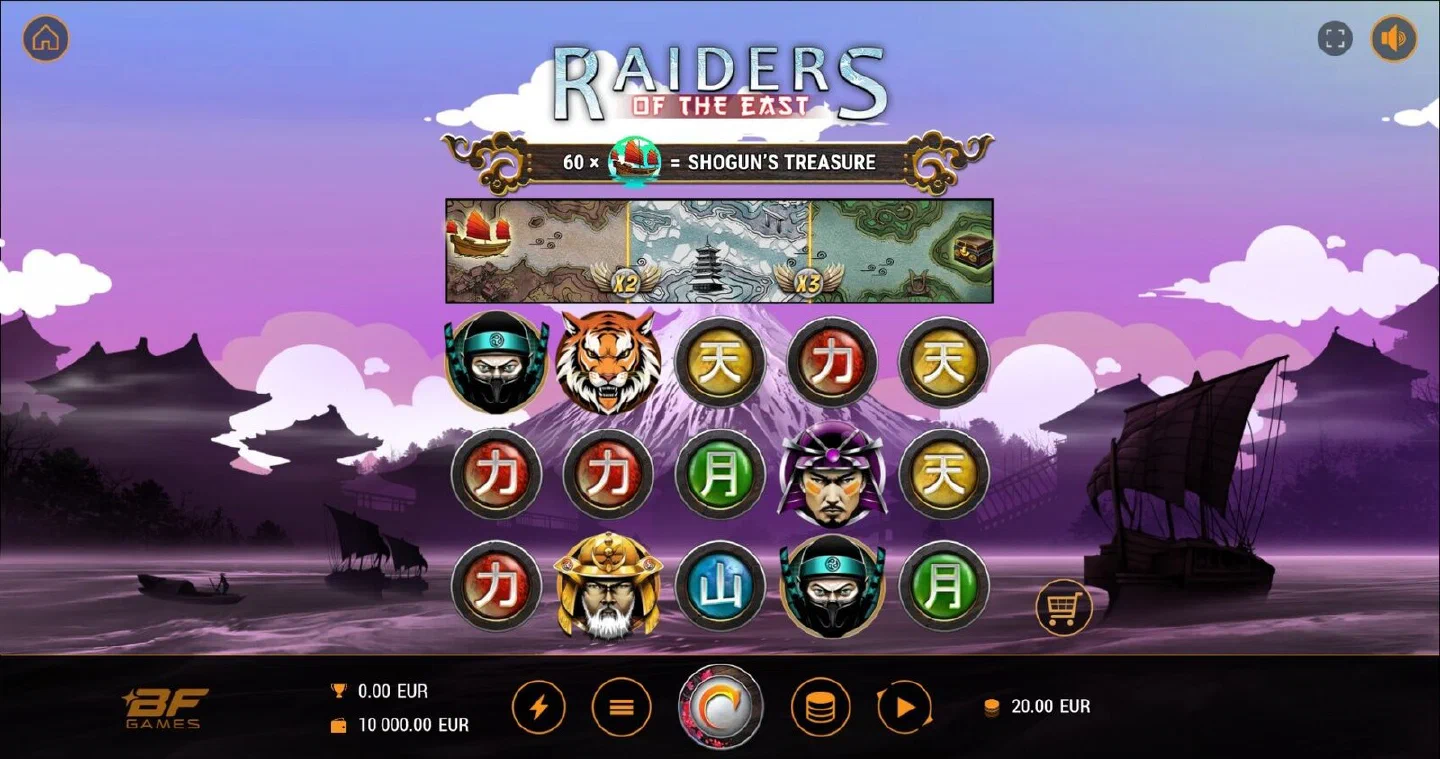
- Find turbo and autoplay. Both controls sit beside the spin button: the lightning icon speeds the reels up, the play icon runs a series for you. Turbo is the one that makes ship collecting bearable.
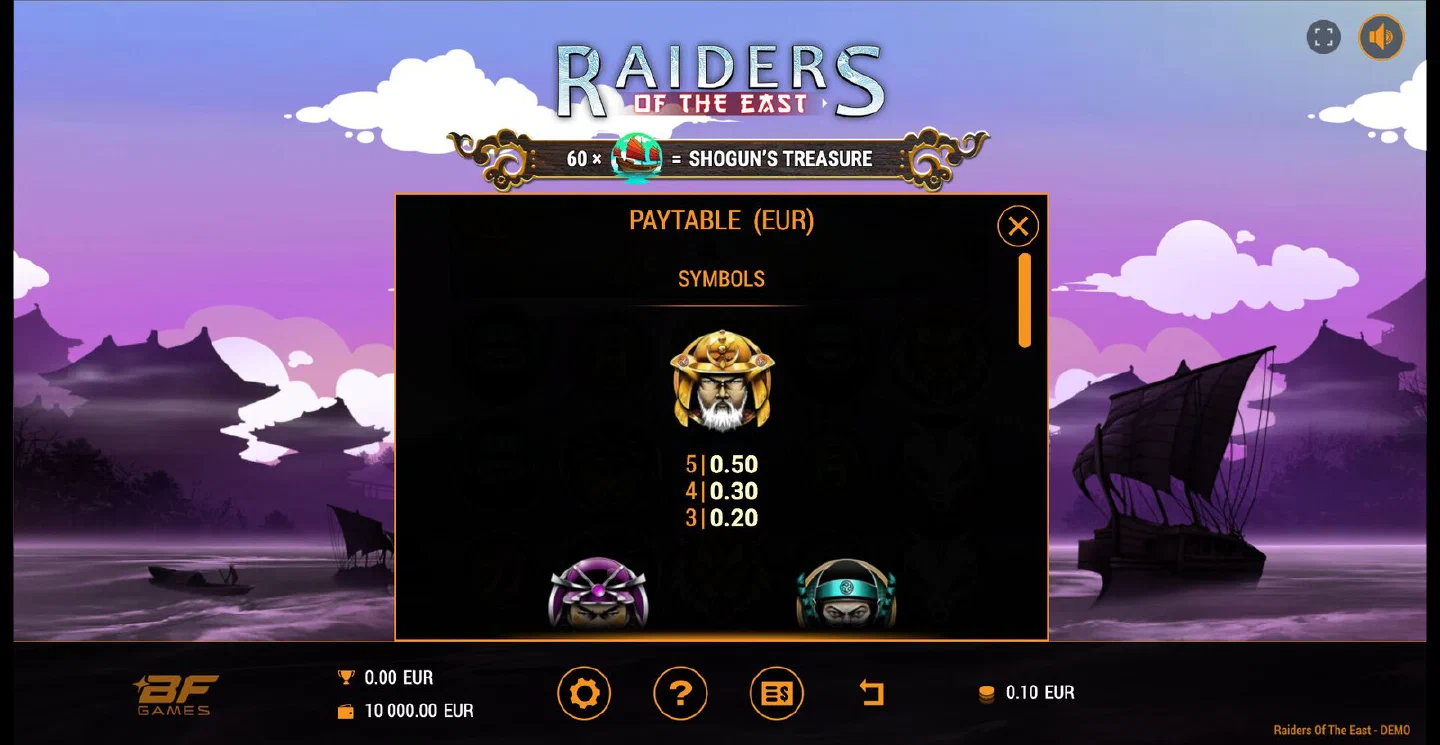
- Open RULES and PAYTABLE. At a 0.10 bet the gold Shogun pays 0.50 for five on a way, 0.30 for four and 0.20 for three. That top line is 5x your bet, which sets the scale for everything else on the panel.
- Wait for the first geisha. She is the Flying Wild. Watch what happens to the kanji discs when she arrives: they are cleared off and replaced by high symbols before the win is counted.
- Watch the ship counter. It is the number that actually decides how your session ends. Twenty ships move the Flying Wild up a tier, sixty change the game outright.
By spin ten you will know whether the rhythm suits you. The how-to-play page has the long version of each of those steps, including how ways are evaluated across adjacent reels.
Reading the board while it spins#
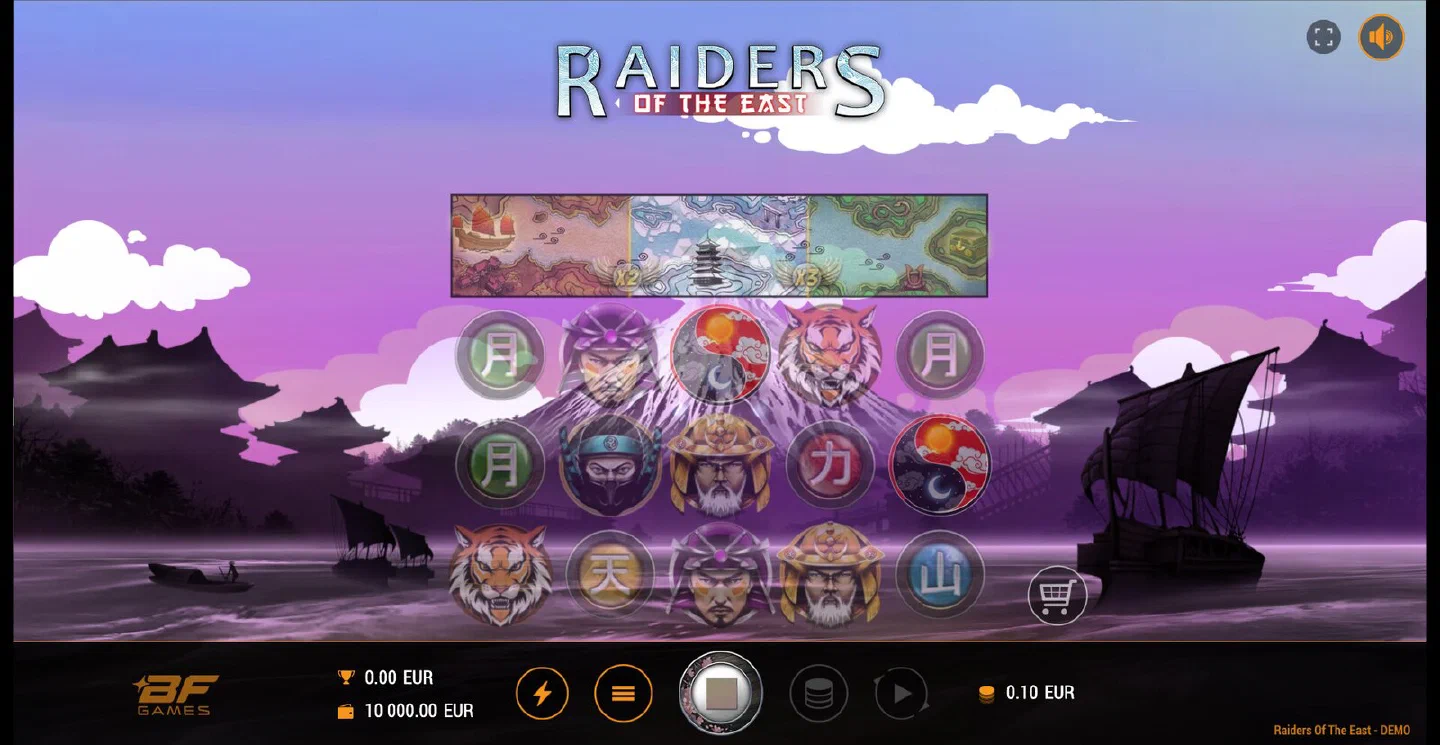
The board splits neatly into symbols that pay and symbols that work, which is what makes the demo quick to learn. At the top of the paying group is the gold Shogun, then the purple samurai, the ninja, the tiger and the kitsune fox. Below them sit four kanji discs in gold, red, green and blue. At a 0.10 bet the ladder runs from 0.50 for five Shoguns down to 0.04 for five of the green or blue kanji, with 0.02 and 0.01 on the four and three-symbol steps.
Those small values matter more than they look. A hit rate of 22.4% puts a win on a little over one spin in five, and the rows it keeps landing on are kanji lines worth a fraction of your stake. They are not the payday. They are the fuel that keeps a session alive long enough for the ship counter to fill, and watching them land in the demo is the fastest way to calibrate what High volatility actually feels like here.
The working symbols are the geisha WILD, the yin-yang SCATTER on reels 1, 3 and 5, the junk-ship SHIP and, once free games are running, the daruma KEY. A samurai in Reel Wild form joins them inside Shogun’s Treasure, covering whole reels on 2, 3 and 4. Learn to spot the ship first: it is the one that changes your afternoon.
A ten-minute demo plan that teaches you something#
Spinning aimlessly on fun money teaches nothing, so give the session a shape. The plan below uses the demo for what it is actually good at, which is rehearsing decisions you will make later with money behind them.
Minutes one to three: base game at 0.10, turbo on. Count how often something pays. You are looking for the rhythm of 22.4%, not for a big win. Note how many spins pass between ship symbols.
Minutes four to six: change the bet once, deliberately. Move up a step and watch what happens to the counter display. This is the lesson the demo exists to teach: the count belongs to the bet you selected, so a stake change resets the progress you were building. Feel that once here and you will never do it by accident on a real balance.
Minutes seven to ten: buy the feature. At 45x the base bet, a purchase on 0.10 costs 4.50 of fun money, which is free tuition on what 10 Free Games with a key ladder actually delivers. Watch how the KEY count climbs, when the multiplier steps up, and how much of the round’s total arrives in the last few spins.
Finish by asking one question: at which stake would that round have been worth 45x to you? That number is your real bet size, and everything on the strategy page builds on it.
What the demo shows and what your own stake adds#
The demo carries the full feature set. Ships fall, the tiers climb, Shogun’s Treasure opens the fourth row, the key ladder runs to x5, and the Buy Feature sits in the bet panel at 45x. Mechanically there is nothing held back.
What changes on a real balance is the weight of the decision. Your own stake owns the ship counter: the count is kept per selected bet, so choosing 0.50 and staying there is a commitment, while hopping between steps on fun money costs you nothing and teaches you nothing. Sixty ships is a real number of spins. Deciding to sit through them is the actual skill this game asks for, and fun money removes the only thing that makes that decision interesting.
The Buy Feature behaves the same way. At 45x the base bet it is 4.50 on a 0.10 stake and 45.00 at 1.00. On fun money those are identical clicks. On your balance they are two very different sessions, and the second price, 55x once the fourth row is open, forces the question of whether to pay more for a better board or keep collecting ships the slow way.
The maths panel is worth a look while you are still on fun money. A 96.3% return with High volatility and a win on 22.4% of spins is a specific promise: a little over one spin in five returns something, and the rest of the return is stored in the top end, where a single round can reach 3168x. The RTP page turns that into stake-by-stake tables, and the features page explains which mechanic is carrying which part of the return.
Demo on the phone#
The client is an HTML5 build weighing 33.8 MB, which is small enough to open over mobile data without a wait, and it is localised into 29 languages, so the interface arrives in yours. The same launcher link serves phone and desktop; the layout reflows, the reels keep their proportions, and the turbo and autoplay controls stay beside the spin button where your thumb already is.
Portrait play suits this slot better than most, because the thing you are tracking is a counter rather than twenty separate paylines. Ships, wild tier, row count. All three read fine on a five-inch screen.
If you would rather have the game sitting on your home screen with a balance attached, the app page covers the casino app for Android and iOS, where the same build runs alongside the rest of the lobby.
From fun money to your own stake#
What changes when the balance is yours is not the game. It is the weight of four things you were treating as free.
The ceiling. 3168x is an abstraction on fun money. At a 0.10 stake it is 316.80, at 1.00 it is 3168.00, and it is a multiple of your own bet rather than a pooled prize everyone in the lobby is feeding. The path to it is the same path you already practised in the demo: wild tiers, the fourth row, the key multiplier.
The counter. On a real balance the decision to hold one bet for sixty ships becomes a plan rather than a shrug, and that plan is the difference between a session that reaches Shogun’s Treasure and one that stops ten ships short.
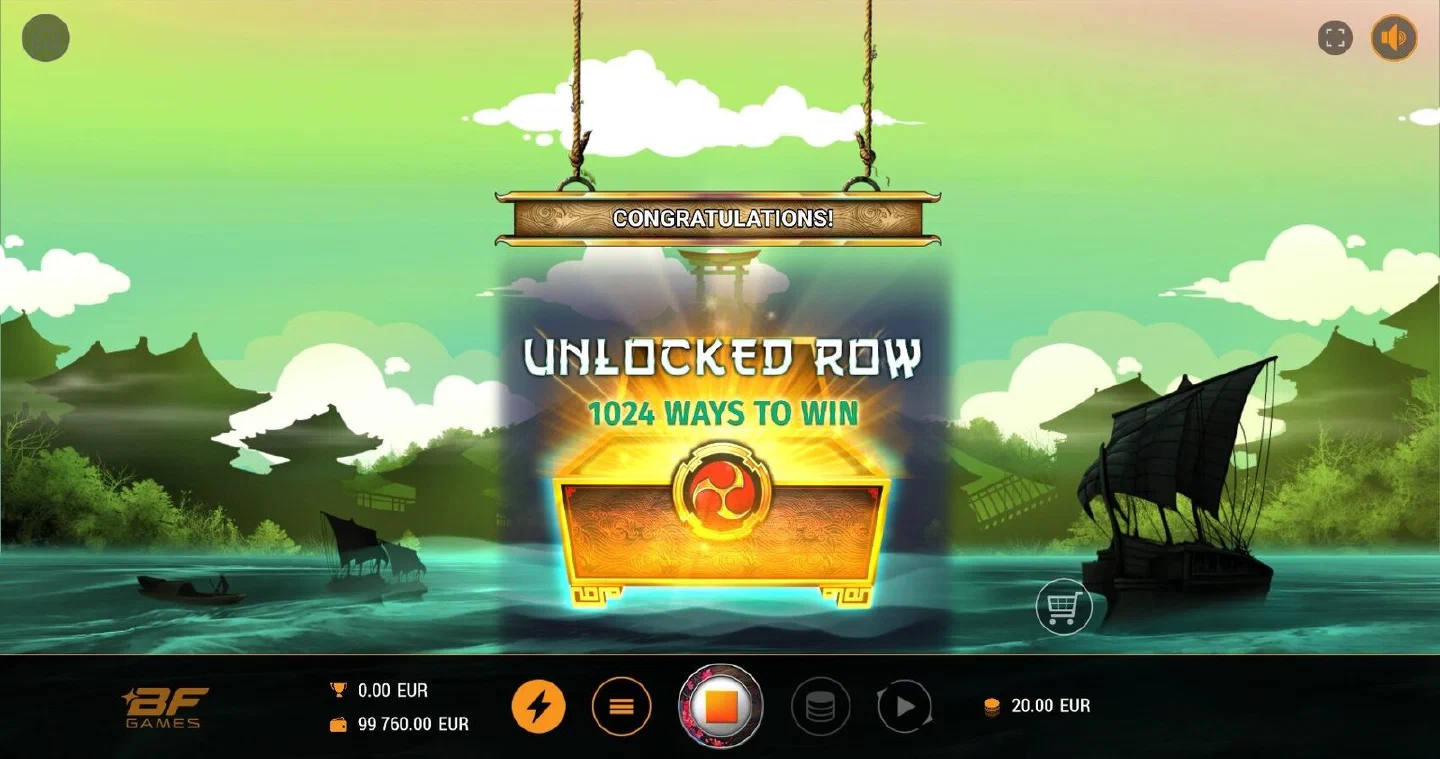
The session boundary. On fun money it is meaningless, because a reload hands you a clean slate and a full balance. On a real stake the session is the unit the whole game is designed around. Shogun’s Treasure stays active until that session expires, which turns an ordinary evening into two distinct halves: the stretch before the fourth row opens, where you are collecting, and the stretch after it, where you are playing a 5x4 board with 1024 ways and a full-reel wild on three of the five reels. Close the tab with the counter short of sixty and the evening ends on the first half; that split is the one thing worth rehearsing here for free.
Everything around the reels. 150+ currencies and cryptocurrencies at the casino side, a welcome offer, a payment method that suits you and an app if you want one. The where to play page lists what to look at first, and the slot hub collects every page in this set.