Flying Wild: three geishas, three outcomes#
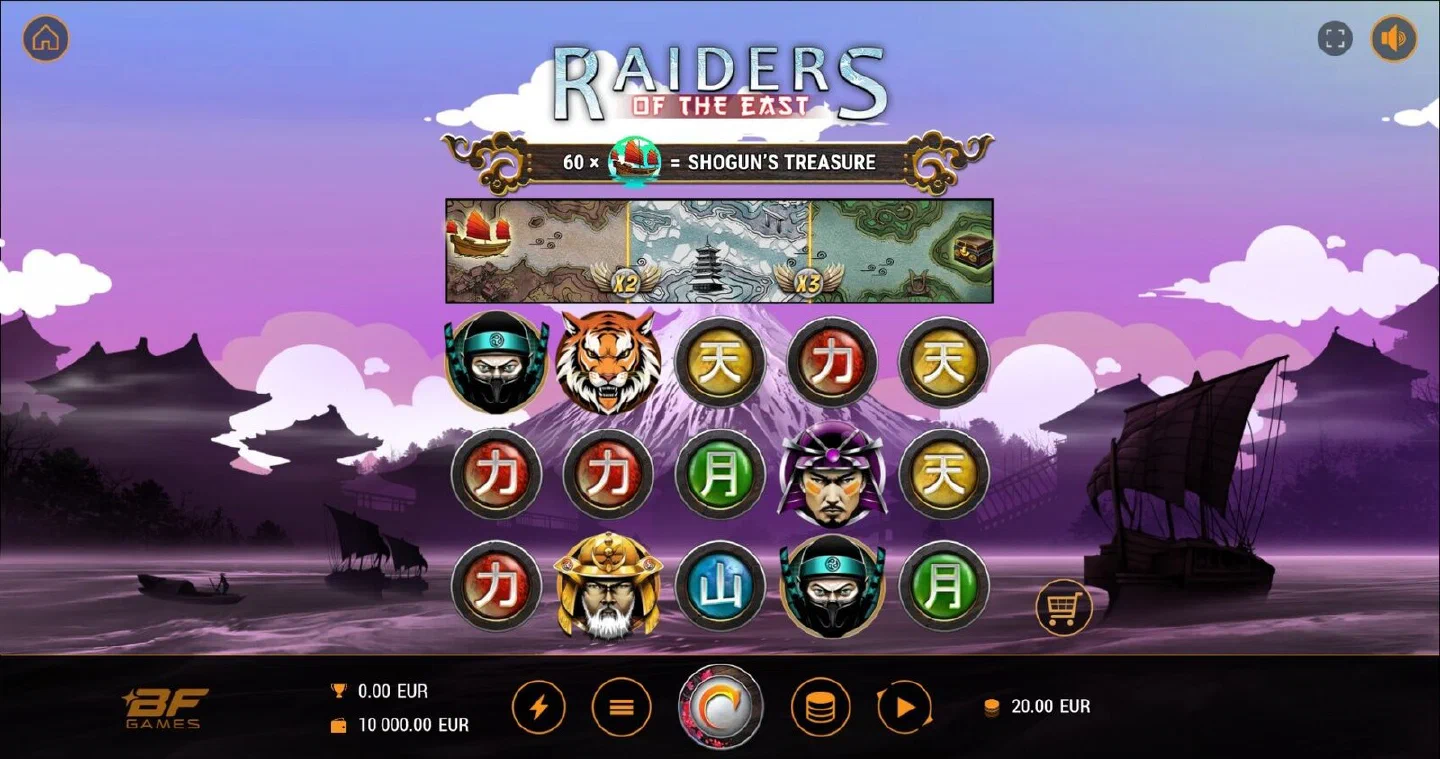
The geisha is the wild, and she arrives in three versions. Gold substitutes with no multiplier. Blue substitutes and multiplies the way by x2. Green substitutes and multiplies by x3. Which one you get depends on how many ships you have collected, which makes the wild the first visible reward of the collection system.
The rules attached to her all matter at the table, and the last one matters most:
- One per spin at most. You will never see two Flying Wilds sharing a screen, so the x3 is a single lever rather than a stacking one.
- Never on reel 1. The leftmost reel always has to supply a real symbol, which is why a way still needs to start honestly before the wild helps it.
- She substitutes for everything except SCATTER and SHIP. The two collector symbols stay untouched, so a wild never costs you a scatter trigger or a ship.
- She rebuilds the board before the win is paid. This is the rule that changes the most money. When a Flying Wild lands, every low symbol on the grid is removed and replaced by a high one, and the win is calculated afterwards.
That last rule is the reason the feature is worth more than its multiplier suggests. A screen full of kanji discs is a screen worth almost nothing; put a geisha on it and those discs become shoguns, samurai, ninjas, tigers and foxes before anything is counted. A gold geisha with no multiplier at all can still turn a dead spin into the best line of the session. Add the x3 on top and a single way of three Shoguns, ordinarily 0.20 at a 0.10 bet, pays 0.60.
The how-to-play page shows where she fits in the order of operations on a spin.
The ship counter: 20, 40, 60#
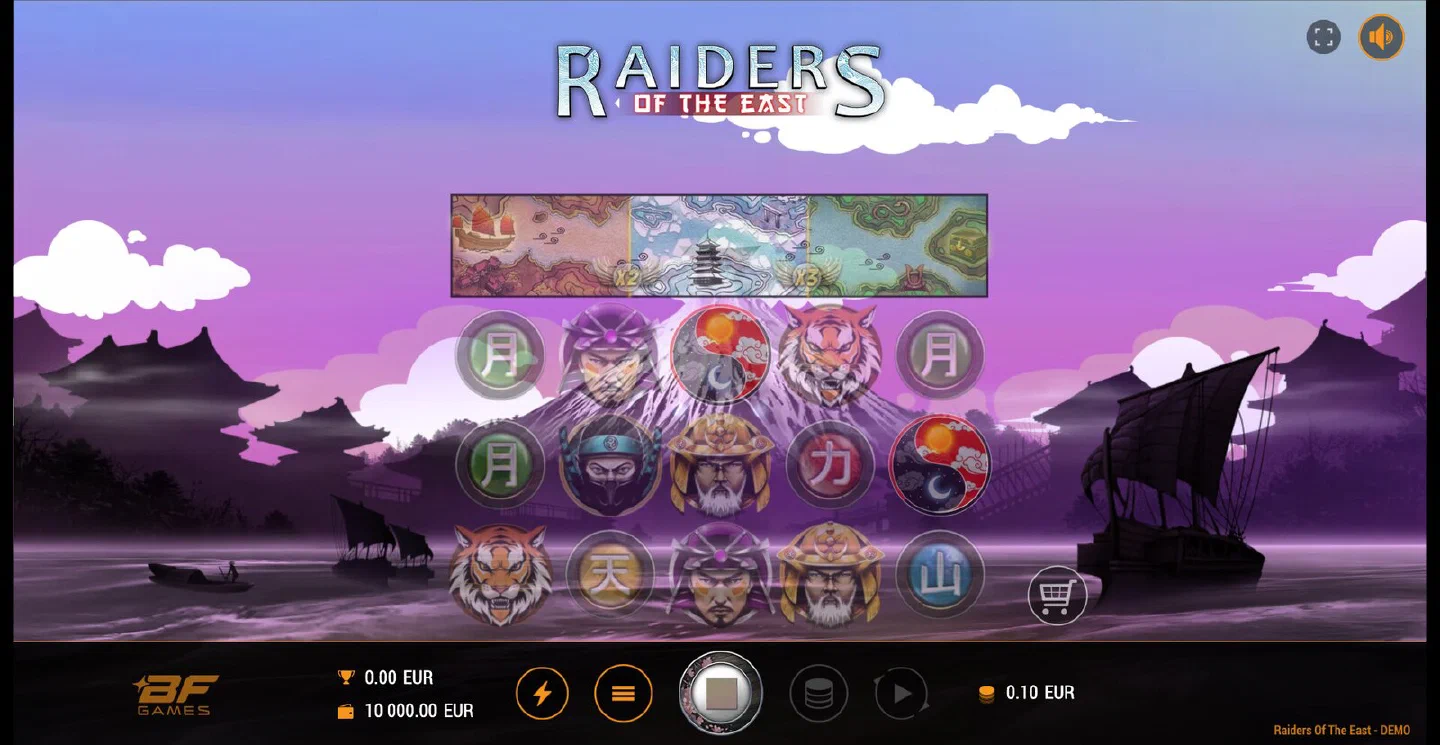
SHIP symbols are junks under red sails, and they fall only in the base game. They pay nothing. They accumulate, and the count is the most important number on the screen.
- 20 ships raise the Flying Wild to its next tier.
- 40 ships raise it again, so the geisha shows up multiplying.
- 60 ships trigger Shogun’s Treasure and open the fourth row.
How you play around that ladder is decided by two properties of the counter. It is kept per selected bet, so your ships belong to the stake you chose; move up a step and you are looking at that step’s own progress, which may be nowhere near sixty. And the whole thing resets when the session ends, which turns a sitting into a self-contained arc rather than a lifetime grind.
In practice this is the simplest piece of advice the game offers: pick a bet you can hold for the whole sitting and hold it. Nudge the stake between steps and the ships you have already landed stay on the step you left, so the run to twenty, forty and sixty starts again from wherever the new step was. Everything in the strategy page is built on that one decision.
Shogun’s Treasure and Reel Wild#
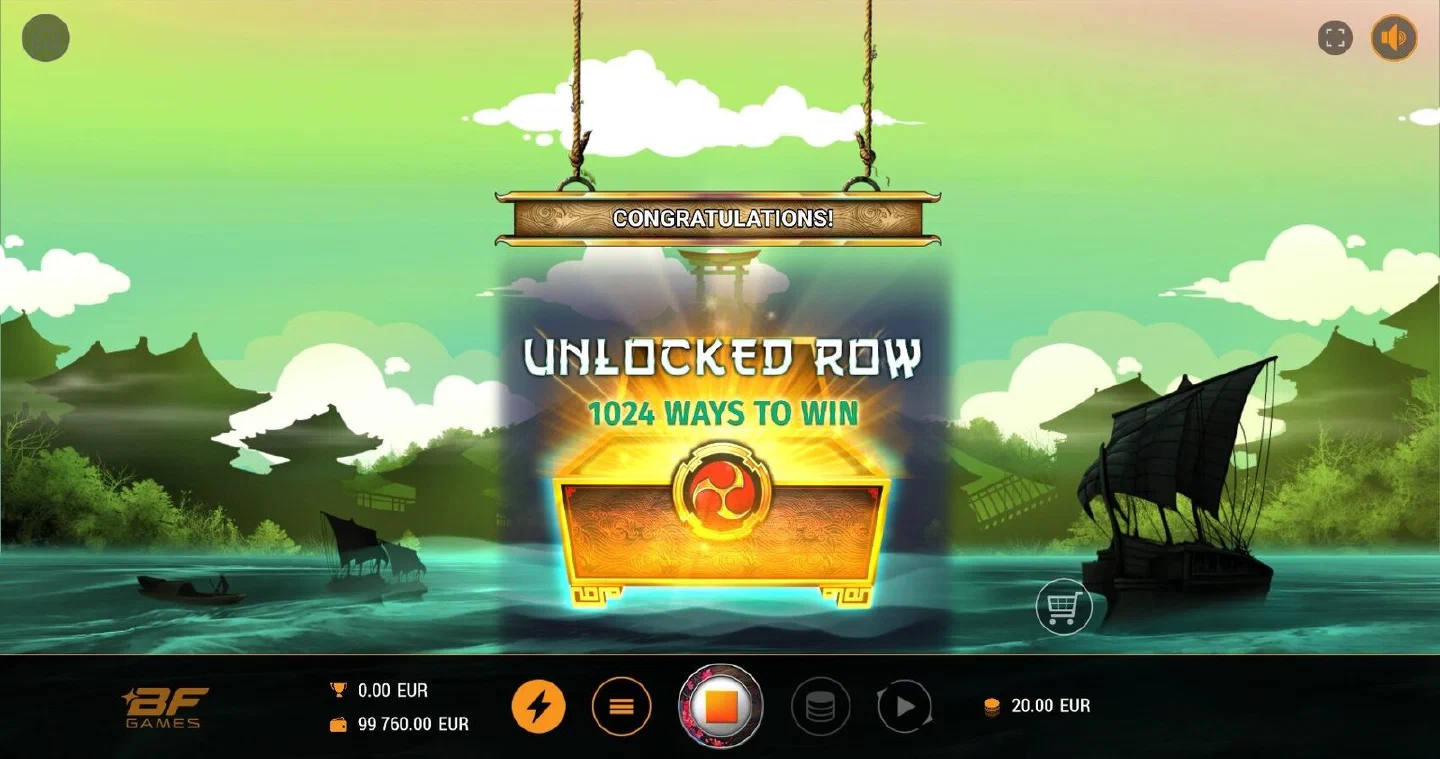
Sixty ships and the game changes shape. A fourth row opens, the grid becomes a 5x4 board with 1024 ways, and REEL WILD switches on. The first unlock also awards a Bonus Respin with a Reel Wild already placed and a win attached to that spin, so the mode announces itself with a payout rather than a message.
Reel Wild is a samurai that expands to cover a whole reel. It appears on reels 2, 3 and 4, substitutes for every symbol except SCATTER, and never shares a spin with a Flying Wild. The two wilds are deliberately kept apart, which keeps the maths legible: either the geisha is rebuilding the board with a multiplier, or up to three full reels are wild underneath 1024 ways.
The word that carries the whole feature is stays. Shogun’s Treasure is active until the session expires. It is not a ten-spin bonus and it does not time out after a dry stretch. Every base spin, every scatter trigger and every bought round from that moment on happens on the bigger board. That is why the game prices the Buy Feature differently before and after the unlock, and it is why the second half of a session here feels like a different game from the first.
One more consequence worth planning around: the return stays at 96.3% whether the row is locked or open. You are not paying for the upgrade in RTP. You are paying for it in patience.
Free Games and the key ladder#
Three SCATTER symbols award 10 Free Games. The yin-yang scatter lands only on reels 1, 3 and 5, and it forms no combination of its own, so the trigger is clean and unambiguous: three reels, three symbols, ten spins.
What happens inside the round is where the ten spins stop being ten spins. A daruma KEY starts appearing, and each milestone does two things at once.
| Keys collected | Extra spins | Round multiplier | Round length so far |
|---|---|---|---|
| 3 | +2 | x2 | 12 spins |
| 6 | +2 | x3 | 14 spins |
| 9 | +2 | x4 | 16 spins |
| 12 | +2 | x5 | 18 spins |
Twelve keys turn 10 Free Games into 18 spins with every win in the round multiplied by five. After the twelfth, no further KEY symbols appear, so the ladder has a defined top and the round cannot run away indefinitely.
The round plays under two rules of its own. Flying Wild is inactive during Free Games, which removes the board-rebuilding mechanic. Reel Wild stays active if Shogun’s Treasure is already on, which means a free-games round on the open board has full reels going wild underneath 1024 ways and a multiplier climbing toward x5. That combination is where the top end of the 96.3% actually lives, and the RTP page puts the numbers next to each other.
Buying the Free Games: 45x or 55x#
The Buy Feature puts the same 10 Free Games straight onto the reels, key ladder included. It is priced as a multiple of your own base bet, and the multiple changes with the state of the fourth row.
| Your bet | Buy at 45x | Buy at 55x |
|---|---|---|
| 0.10 | 4.50 | 5.50 |
| 0.50 | 22.50 | 27.50 |
| 1.00 | 45.00 | 55.00 |
| 5.00 | 225.00 | 275.00 |
| 20.00 | 900.00 | 1100.00 |
| 100.00 | 4500.00 | 5500.00 |
Bets open at 0.10 a spin and the top step is 100 or 200 depending on the casino you open the game in, so the table above scales across the whole range you are likely to use.
The price rises exactly when the game has become better, which is unusually honest pricing. At 45x you are buying the round onto a 5x3 board. At 55x you are buying it onto a 5x4 board with 1024 ways and Reel Wild live during the spins. The extra 10x of base bet is the toll on that upgrade, and it is the configuration the 3168x ceiling is built around.
The return moves a little when you buy: 96.06% with the row locked and 95.93% with it open, against 96.3% in the base game. That is 0.24 of a percentage point on the first path and 0.37 on the second, so the purchase is a decision about style and pace rather than about value leaking away.
The paytable, and why the low symbols matter#
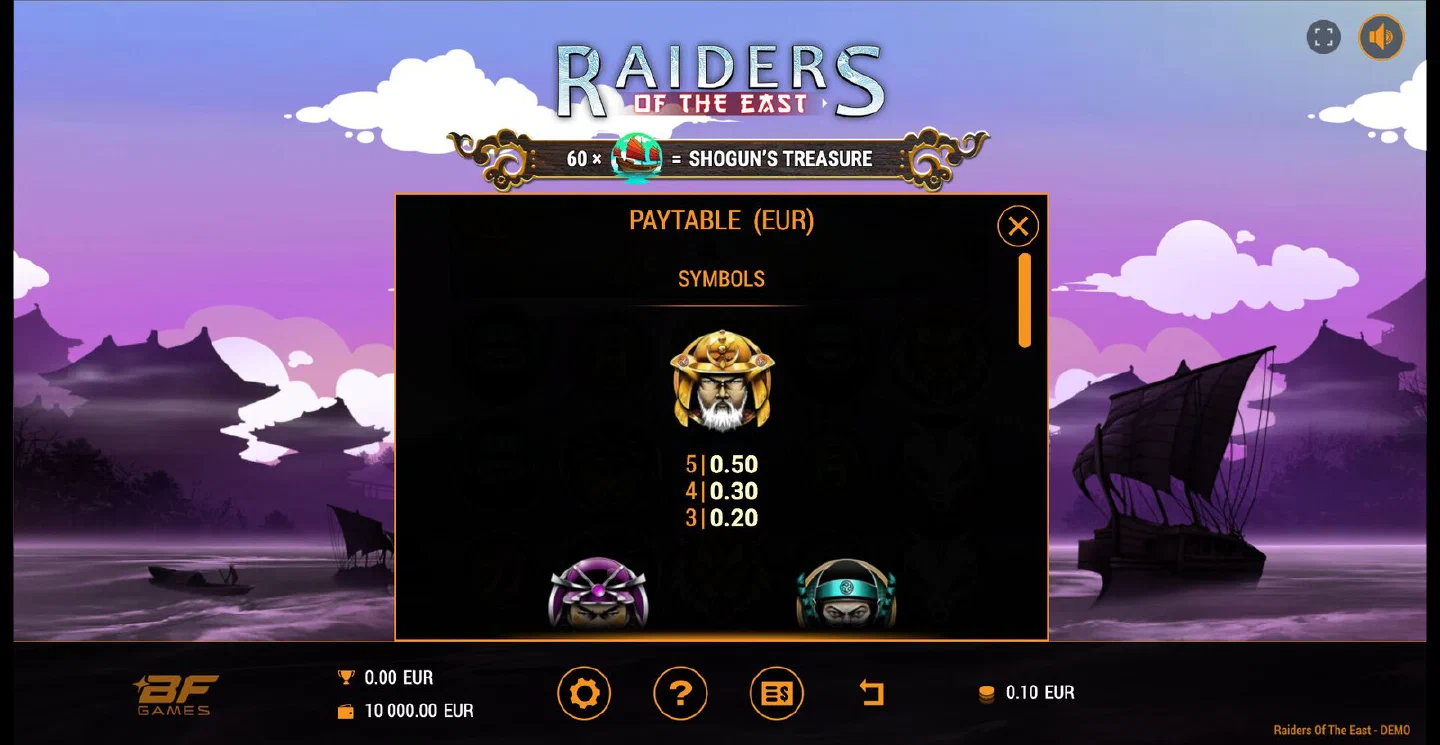
The values panel is published at a 0.10 bet, which makes it easy to convert into multiples of whatever stake you use. The gold Shogun tops it at 0.50 for five on a way, 0.30 for four and 0.20 for three. The purple samurai follows at 0.30, 0.10 and 0.05. The ninja runs 0.15, 0.08 and 0.03. The tiger and the kitsune fox share 0.10, 0.05 and 0.02. Below them the four kanji discs pay 0.05, 0.03 and 0.02 for the gold and red pair, and 0.04, 0.02 and 0.01 for the green and blue.
The bottom of that panel is the part of the game you will actually spend your evening inside. A win lands on 22.4% of spins, a little over one in five, and the values sitting on the four and three-symbol rows are where most of that contact is priced: 0.02 and 0.01 for the green and blue kanji at the minimum stake, 0.03 and 0.02 for the gold and red pair. They are not the prize. They are the reason a session at 0.10 can run long enough for sixty ships to land.
That also explains why the wilds carry so much of the design. When the whole paytable tops out at 5x a stake for a perfect line, the only way to reach a 3168x round is through multiplication and width: a x3 geisha, a x5 key ladder and 1024 ways counting the same combination repeatedly. The symbols set the floor; the features set the ceiling.
Wins are evaluated left to right on adjacent reels from the leftmost reel, only the highest combination is paid per way, and wins from separate ways are added together. On a 5x3 board that keeps the arithmetic simple. On the open 5x4 board it is why a dense screen can resolve into a payout several times larger than it looks.
How the five features chain together#
Read as a chain rather than a list, the design becomes obvious. Base spins drop ships. Ships raise the geisha’s tier, so the base game slowly gets better at paying. Sixty ships open the fourth row, so the base game gets wider and gains a second wild type. Scatters open Free Games, and on the open board that round runs with Reel Wild live. Keys inside the round stretch it to 18 spins and multiply it by five.
Every link makes the next one worth more. That is the reason the Buy Feature has two prices, the reason Shogun’s Treasure lasts a session instead of ten spins, and the reason this slot rewards sitting still at one stake far more than most.
How a big round is actually built#
The ceiling is 3168x your bet, and the path to it is made of three separate steps rather than one lucky spin.
Step one is the wild multiplier. A green Flying Wild applies x3 to its way after rebuilding the board with high symbols. That is the base game doing its best work.
Step two is the board. With the fourth row open, 1024 ways mean a single five-of-a-kind can be counted many times over, and a full-reel wild on reels 2, 3 and 4 makes those counts realistic rather than theoretical.
Step three is the key ladder. Twelve keys multiply everything in an 18-spin round by five.
Stack the three and the arithmetic to 3168x stops looking like a fantasy. At a 0.10 stake that ceiling is 316.80 for one round; at 1.00 it is 3168.00. A win lands on 22.4% of spins along the way and volatility is High, so the small hits are company rather than income, and the round you are actually playing for is the one where all three steps are in place.
Read the full review for how that plays over an evening, browse the similar slots page for neighbours with the same appetite, or return to the slot hub for everything else in this set.

18+. Features change how a round plays, never the odds behind it. Set your limits first: the responsible gambling page shows how.