What BF Games shipped here#
Raiders of the East arrived on 26 August 2026 on client version 1.1.0, filed under game id BFGraiders-of-the-east, in a JS and HTML5 client weighing 33.8 MB. That matters for one practical reason: the mechanics underneath behave like something built from the counter outwards rather than a theme dropped over a standard five-reel frame, and the ship meter is what the whole session hangs on.
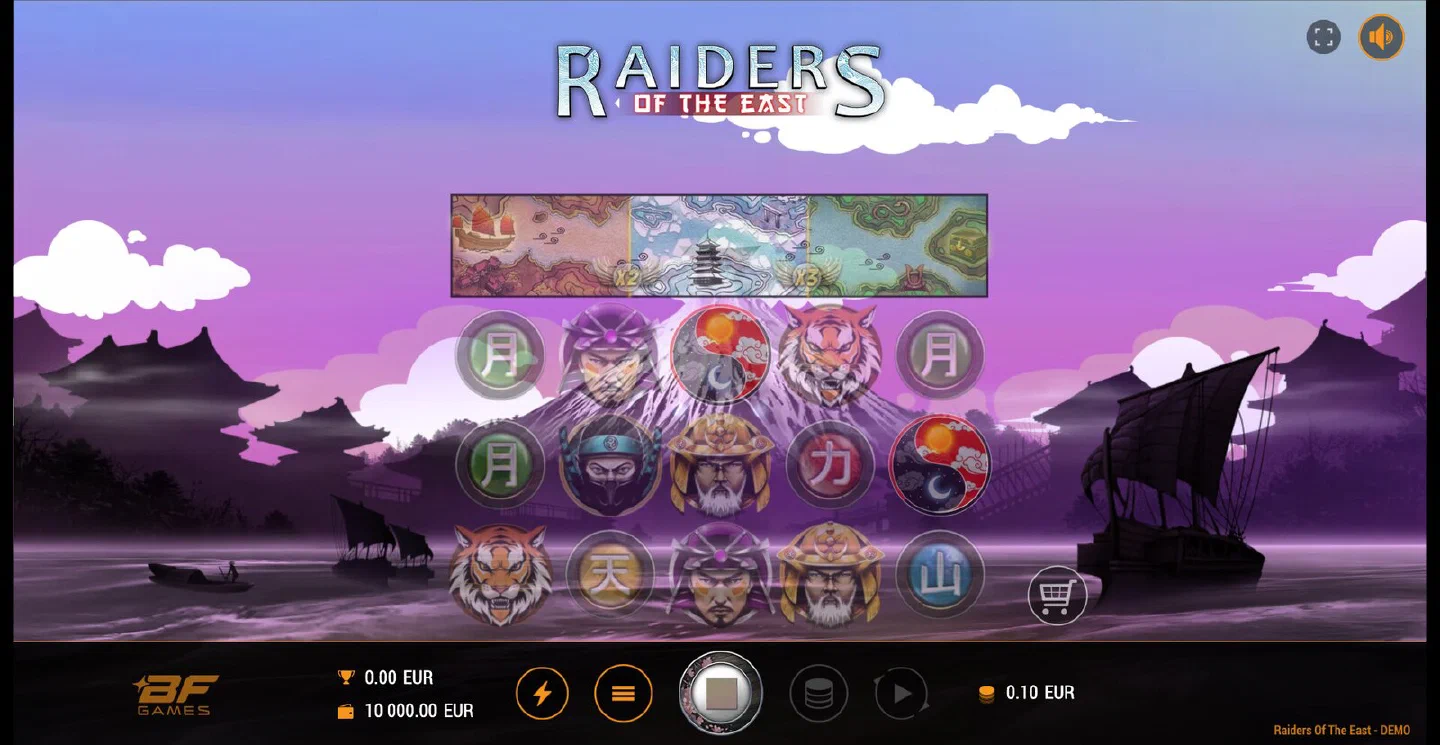
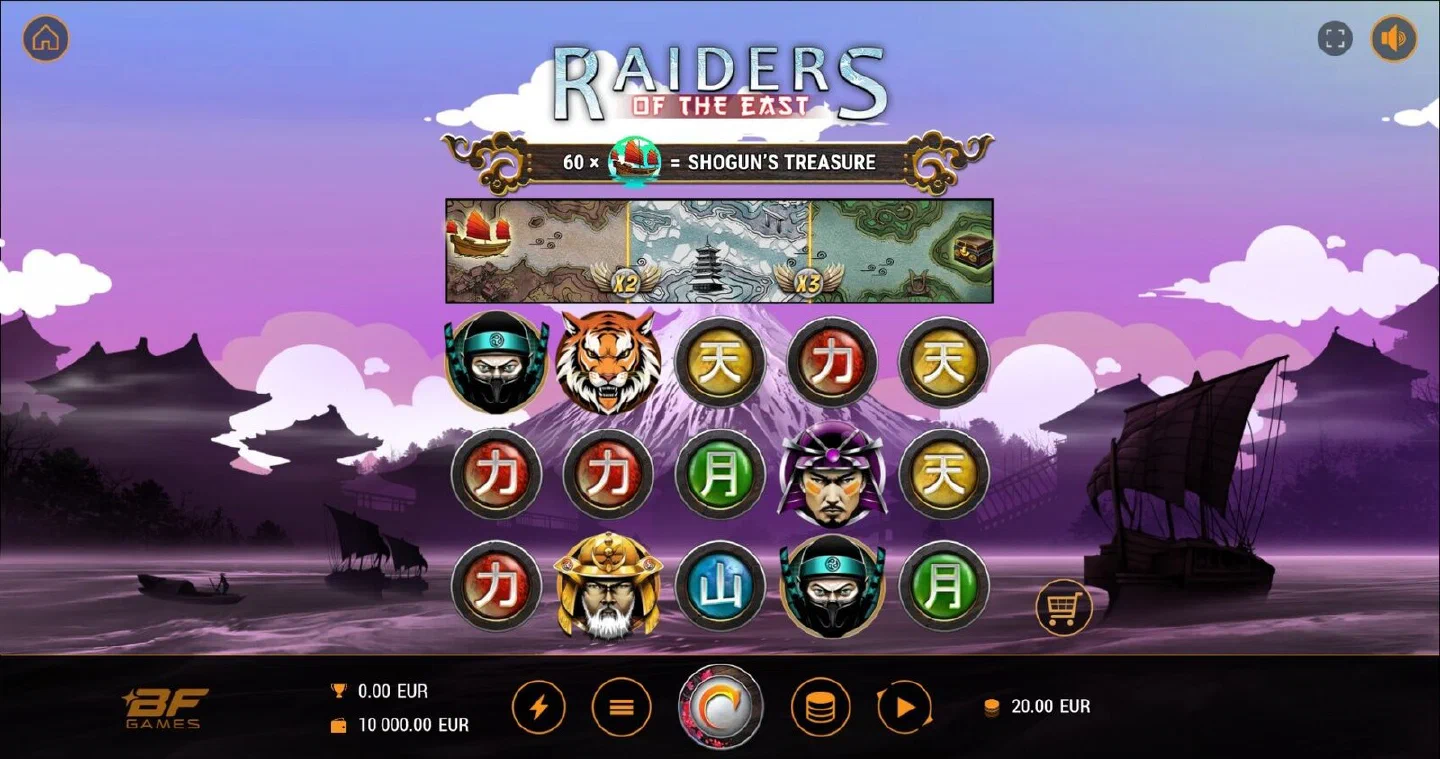
The provider files it as an Asian video slot and tags it Asian, Buy feature, Characters and TOP 10. Coverage at launch placed it as the second instalment of a BF Games line, which is the kind of note that tells you the studio intends to keep building here. On the board that translates into a cast with personality: a gold Shogun, a purple samurai, a ninja, a tiger and a kitsune fox above four kanji discs, with a geisha doing wild duty and a junk under red sails counting your progress.
One clarification before the mechanics, because the two titles get mixed up in search results and aggregator cards alike. BF Games also publishes Raiders of the East Dice, a separate title carrying the same name, with its own rules and its own provider page. This review is about the reel version, the one with wilds, scatters and a fourth row. If you want the studio’s wider catalogue and its licensing, the BF Games page covers both.
The ship counter is the best thing in the game#
Collection meters are standard equipment on a modern slot. What is not standard is a meter that rewrites the board and then leaves it rewritten, and that single design choice is what lifts this game above the shelf it sits on.
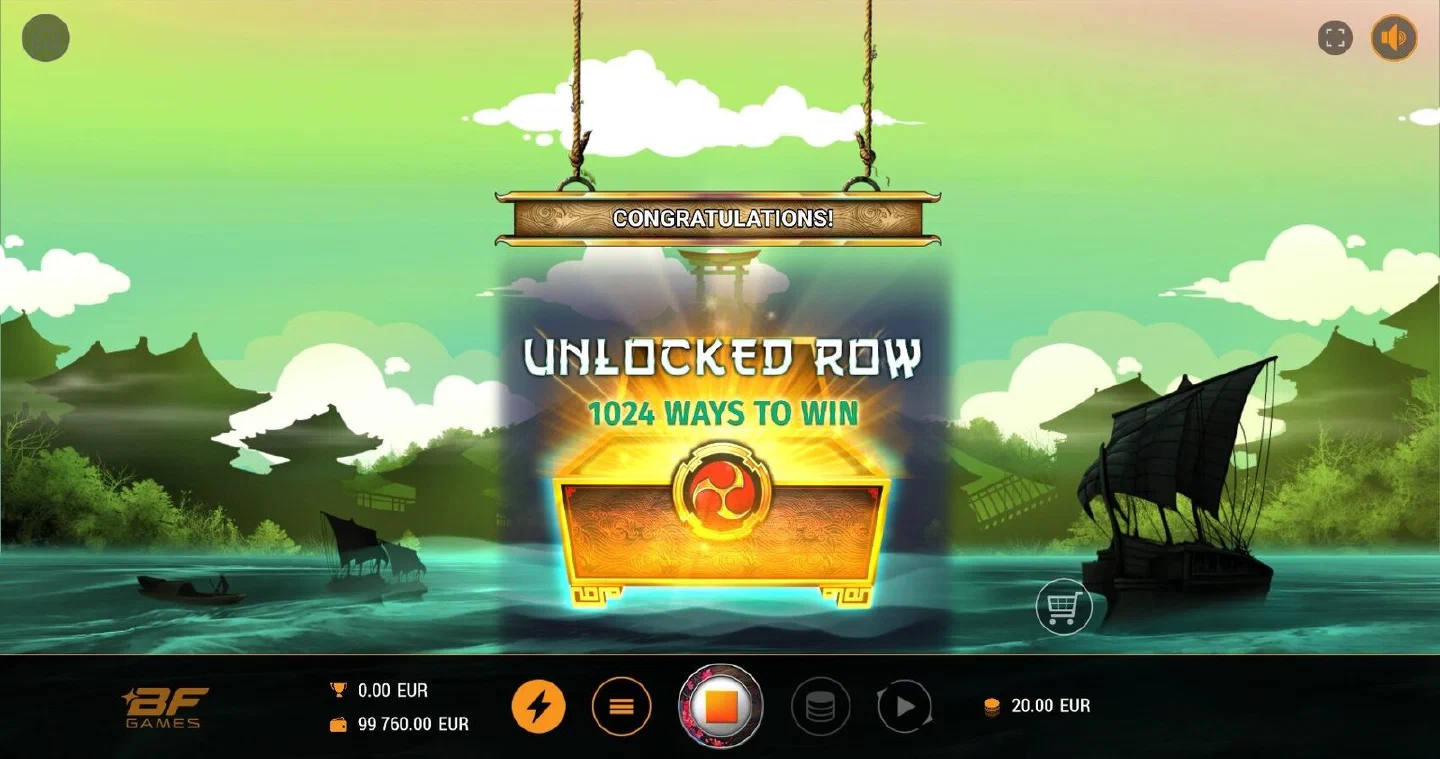
SHIP symbols fall in the base game and go onto a counter. Twenty of them buy a better wild, forty buy a better one again, and sixty buy the fourth row and Shogun’s Treasure outright. Judged as a reward curve that is unusually honest work: each milestone is a mechanical change you can see on the next spin rather than a badge.
What keeps it from being decoration is how strictly it is scoped. The counter is kept per selected bet, so your progress belongs to the stake you chose and jumping steps splits your effort across separate counts. And the whole thing resets when the session ends, which gives a sitting a natural arc. You are not grinding toward a lifetime total. You are trying to get somewhere before you stand up.
The Flying Wild tiers are the reward for the first two-thirds of that climb. The gold geisha substitutes with no multiplier, the blue applies x2 and the green x3. One lands per spin at most and never on reel 1, and her arrival sweeps every low symbol off the board and replaces it with a high one before the win is calculated. That ordering is the reason a green geisha can turn a screen full of kanji into a line of shoguns at triple value.
Then the fourth row opens, Reel Wild switches on across reels 2, 3 and 4 as a full-reel symbol substituting for everything but SCATTER, and the first unlock hands you a Bonus Respin with a Reel Wild already placed. From then on you are playing a 5x4 board with 1024 ways until the session expires.
Free Games and the key ladder#
Three SCATTERs award 10 Free Games. The yin-yang scatter appears only on reels 1, 3 and 5 and forms no combination of its own, so the trigger is clean: three specific reels, one specific symbol, ten spins. What happens next is where BF Games did the interesting work.
| Keys collected | Extra spins | Round multiplier |
|---|---|---|
| 3 | +2 | x2 |
| 6 | +2 | x3 |
| 9 | +2 | x4 |
| 12 | +2 | x5 |
The daruma KEY drops during the round and does both jobs with the same symbol: length and value. Twelve keys turn 10 Free Games into 18 spins with every win multiplied by five, and after the twelfth no further keys appear, so the ceiling of the round is defined rather than open-ended. Flying Wild sits out the free games, but Reel Wild keeps working if Shogun’s Treasure is already running. That is the strongest argument in the game for opening the fourth row before you go hunting scatters, and it is also the reason the Buy Feature costs more afterwards.
The features page takes each of those mechanics apart in detail, including how the two wild types share the board.
Paytable: what a full line is actually worth#
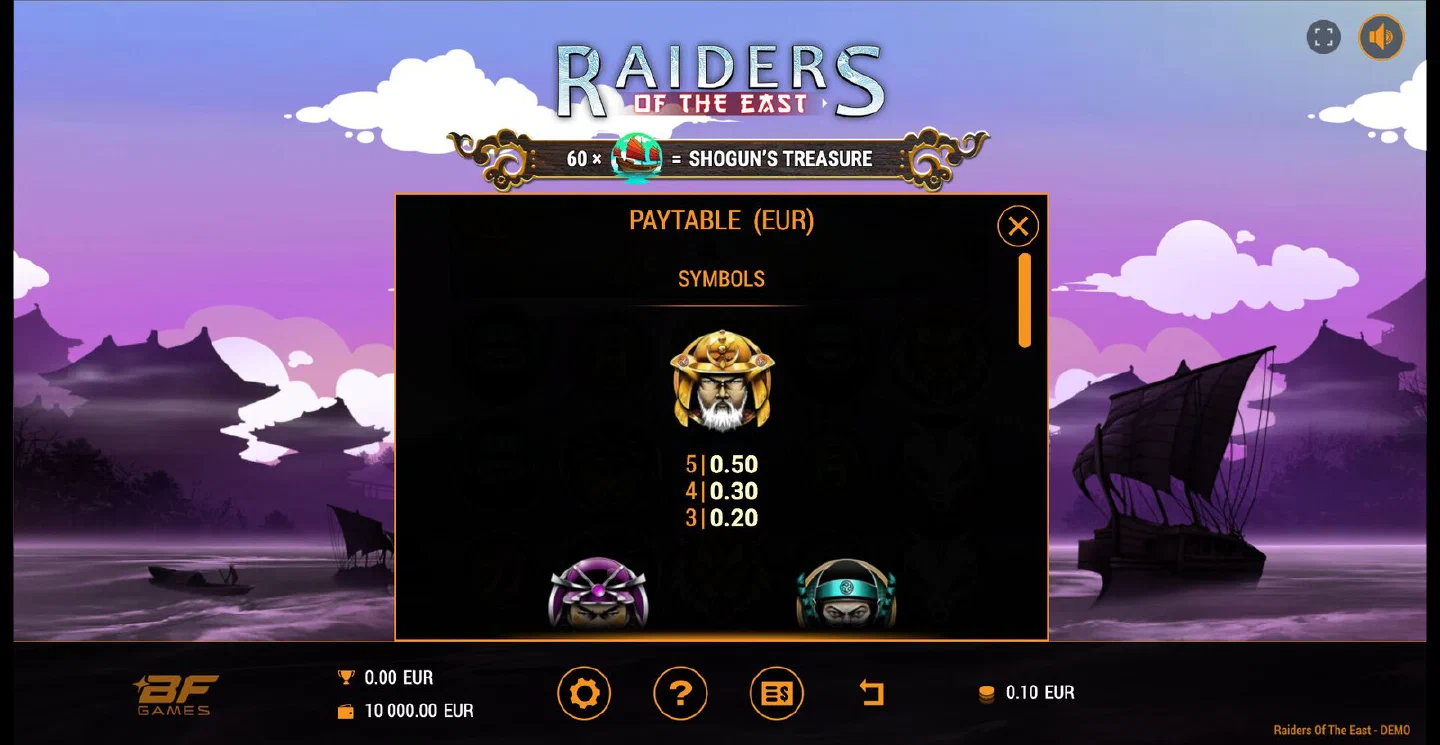
The top symbol is the least useful row on the panel, because the four and three-symbol steps are the ones a 22.4% hit rate keeps landing on. So here is the whole thing at a 0.10 bet.
| Symbol | Five | Four | Three |
|---|---|---|---|
| Gold Shogun | 0.50 | 0.30 | 0.20 |
| Purple samurai | 0.30 | 0.10 | 0.05 |
| Ninja | 0.15 | 0.08 | 0.03 |
| Tiger | 0.10 | 0.05 | 0.02 |
| Kitsune fox | 0.10 | 0.05 | 0.02 |
| Kanji, gold and red | 0.05 | 0.03 | 0.02 |
| Kanji, green and blue | 0.04 | 0.02 | 0.01 |
Read the top line as a multiple and the scale becomes obvious: five Shoguns pay 5x your bet, four pay 3x, three pay 2x. Everything below that is a fraction of a stake, and that is by design. The base game is a holding pattern that keeps you in contact with the reels while the ship counter fills; the real money is stored in the multiplied free-games round and in the 1024-way board.
It also explains why a single Flying Wild matters so much. Three shoguns pay 0.20 at this stake. Put a green geisha in that way and the same combination pays 0.60. Swap in five shoguns with an x3 and the 0.50 becomes 1.50. The RTP and maths page scales all of it to your own stake.
The Buy Feature, priced honestly#
Charging two different prices for the same 10 Free Games is an unusual bit of design, and it is the clearest signal the game sends about its own economics. Before the fourth row opens, the round costs 45x the base bet. After it opens, the same round costs 55x. The extra is what BF Games thinks a 5x4 board with a full-reel wild is worth, and it is hard to argue with the reasoning.
| Your bet | Buy at 45x | Buy at 55x | What the ceiling pays at that stake |
|---|---|---|---|
| 0.10 | 4.50 | 5.50 | 316.80 |
| 0.50 | 22.50 | 27.50 | 1584.00 |
| 1.00 | 45.00 | 55.00 | 3168.00 |
| 5.00 | 225.00 | 275.00 | 15840.00 |
| 100.00 | 4500.00 | 5500.00 | 316800.00 |
The right way to read that table is as a trade in spins, not in money. A purchase at 45x costs what forty-five base spins cost at the same stake; at 55x, what fifty-five cost. Set that against the collection path and the two are doing different jobs. Ships fall in the base game only, so the path to the fourth row is paid for in base spins at one stake, and what it buys is permanent: 5x4, 1024 ways and Reel Wild until the session ends. A purchase buys one multiplied round, immediately, at 96.06% rather than 96.3%, and leaves the counter and the board exactly where they were.
Buying after the row is open is the stronger case, and the game prices it that way deliberately. At 55x you are putting 10 Free Games with a live key ladder onto a 1024-way grid where Reel Wild is still active during the round. That is the configuration the 3168x ceiling is built for, and it is the only one where all three multipliers, the wild tier, the open row and the x5 key stack, can appear in the same sequence of spins.
The note that keeps this honest: the Buy Feature moves the published return slightly, to 96.06% before the row opens and 95.93% after it. Both figures are close enough to the 96.3% base model that the decision is about style rather than arithmetic, and the RTP page sets them side by side.
Who this slot is for#
High volatility with a win on 22.4% of spins is a specific combination, and it suits a specific player. At that rate the session never goes silent, but the size of those wins is small until the machinery starts working. The return is stored at the top, in the rounds where a wild tier, an open fourth row and an x5 key multiplier line up, and in the 3168x ceiling that sits above them.
If you want steady, frequent, similar-sized wins, this is the wrong shelf; the comparison with Demi Gods VI lines it up against a game built for exactly that instead. If you like the idea of a session with a goal in it, where the board you finish on is not the board you started on, it is one of the more interesting Asian slots released this year.
One more audience deserves a mention: the player who has grown tired of slots that feel identical on spin one and spin four hundred. This one genuinely does not. The board you finish an evening on is a different board from the one you started on, and that alone earns it a place in the rotation even for people who would normally pass on an Asian theme.
Practically: pick a bet you can hold, give it enough spins to reach 60 ships, and treat the Buy Feature as a shortcut you take with a reason rather than out of impatience. The strategy page turns that into a session plan, and the slot hub collects everything else in one place.