What high volatility feels like here#
High volatility with a win on 22.4% of spins is a specific rhythm, and knowing it in advance is worth more than any betting pattern.
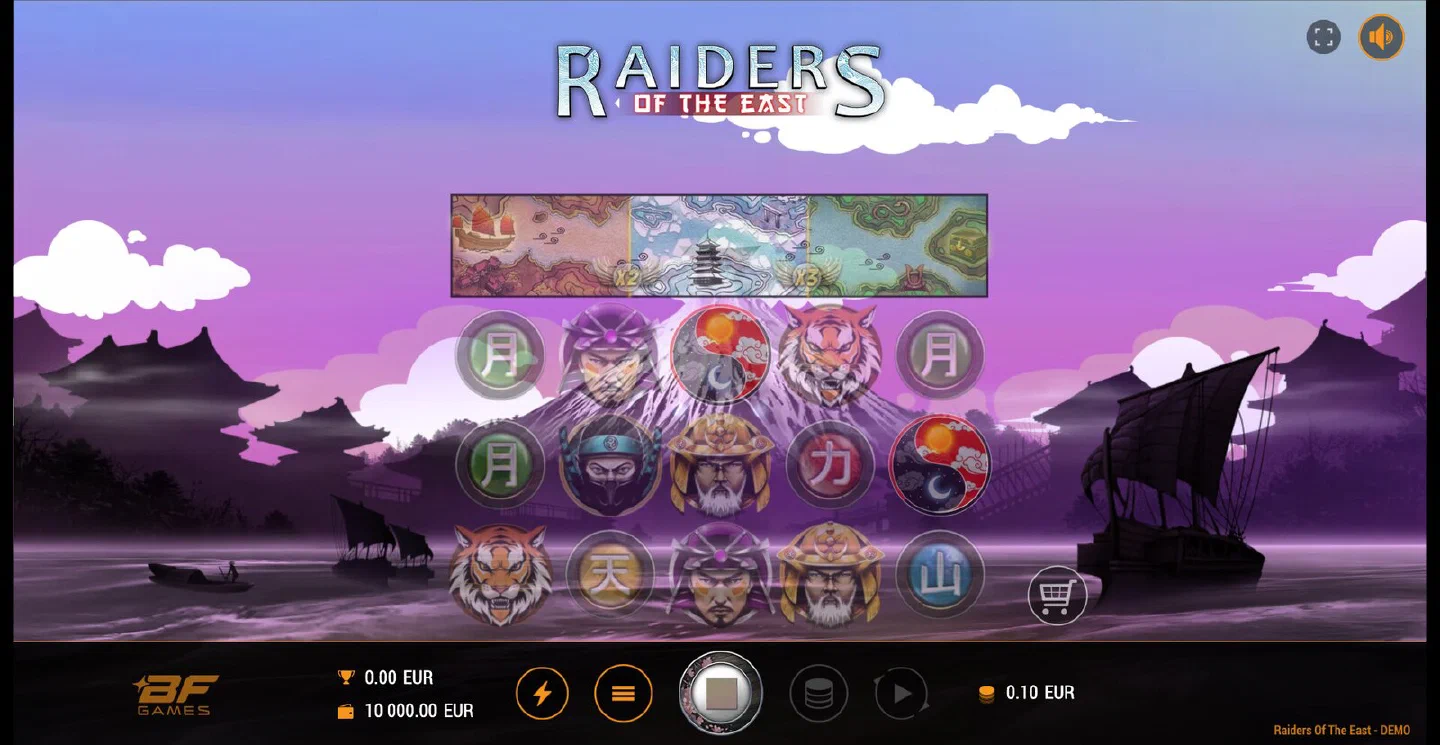
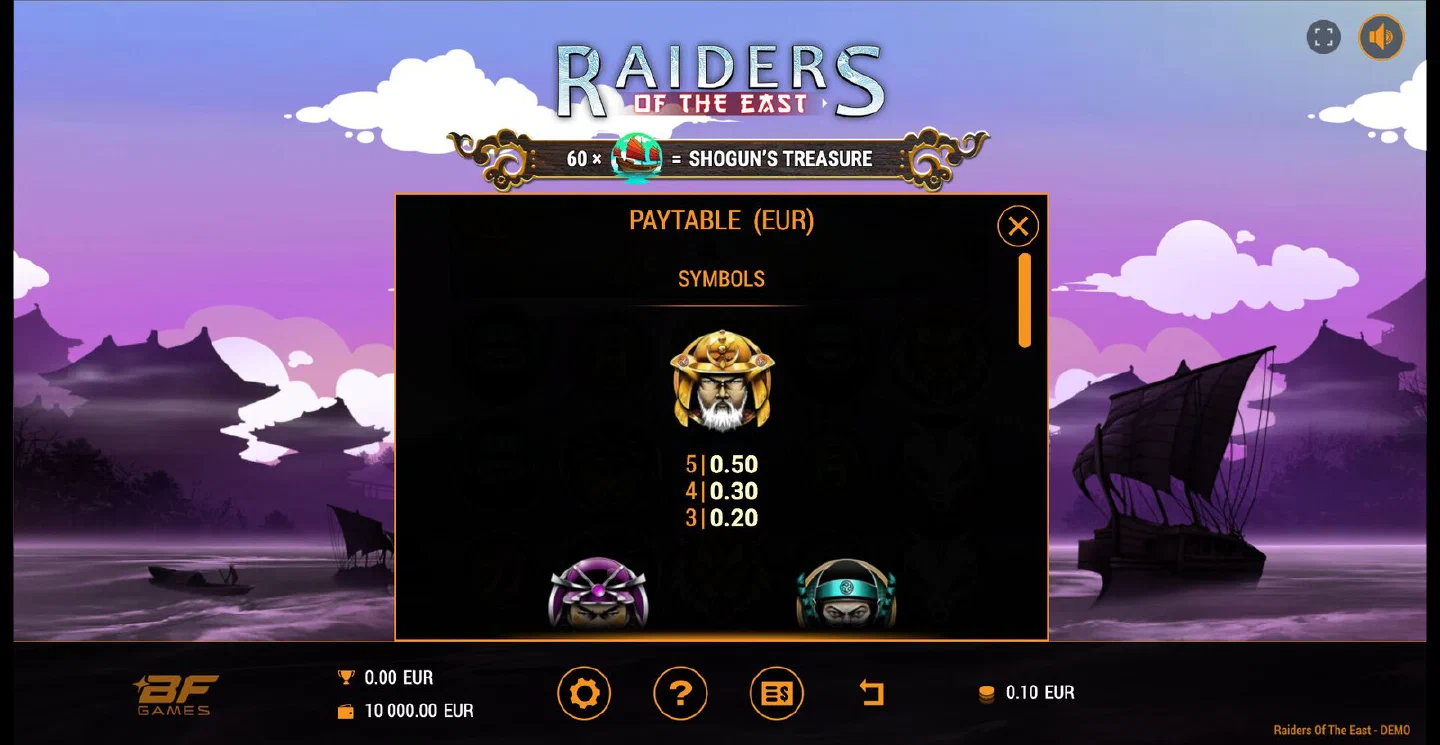
At 22.4% something lands a little more often than once every five spins. That is frequent contact, and it keeps the screen alive while the ship counter fills. What those wins are not is large: the base paytable tops out at 5x a stake for five gold Shoguns, and most hits are three-symbol kanji lines worth a fraction of the bet. The balance drifts downward through the collection phase even while the game is paying you regularly. That is the design working as intended, rather than a bad run.
The rest of the 96.3% is stored where the multipliers are. A green Flying Wild applies x3 to the way it completes. A free-games round with twelve keys collected multiplies everything in it by x5 across 18 spins. Open the fourth row underneath and 1024 ways start counting the same combination repeatedly.
The practical conclusion: plan a session, not a spin. A player who budgets by the round and leaves while the counter is still short of sixty has paid for the collection phase and skipped the payoff phase entirely. The RTP page has the full maths, and everything below is about arranging your money so the second half actually happens.
Choosing a bet you can hold#
This is the one decision with real consequences, because the ship counter is kept per selected bet. Choose the step you will still be on when the session ends.
| Your bet | 200 base spins cost | Buy at 45x | Ceiling at 3168x |
|---|---|---|---|
| 0.10 | 20.00 | 4.50 | 316.80 |
| 0.20 | 40.00 | 9.00 | 633.60 |
| 0.50 | 100.00 | 22.50 | 1584.00 |
| 1.00 | 200.00 | 45.00 | 3168.00 |
| 2.00 | 400.00 | 90.00 | 6336.00 |
Two hundred base spins is simply a round unit for pricing a sitting: the second column is what that many spins cost on each step, nothing more. Ships land during the base game and sixty of them is the target, so the useful question is which row lets you keep spinning on one stake without the figure swallowing your whole session budget. Pick that row and stay on it, because the counter belongs to the stake you chose.
The mistake to avoid is the familiar one: starting low, feeling impatient, jumping two steps up, and discovering that the higher step has its own counter starting from wherever it was left. The game is not penalising you. It simply tracks progress per stake, and the sensible response is to make the choice once.
The sixty-ship run: pacing a session#
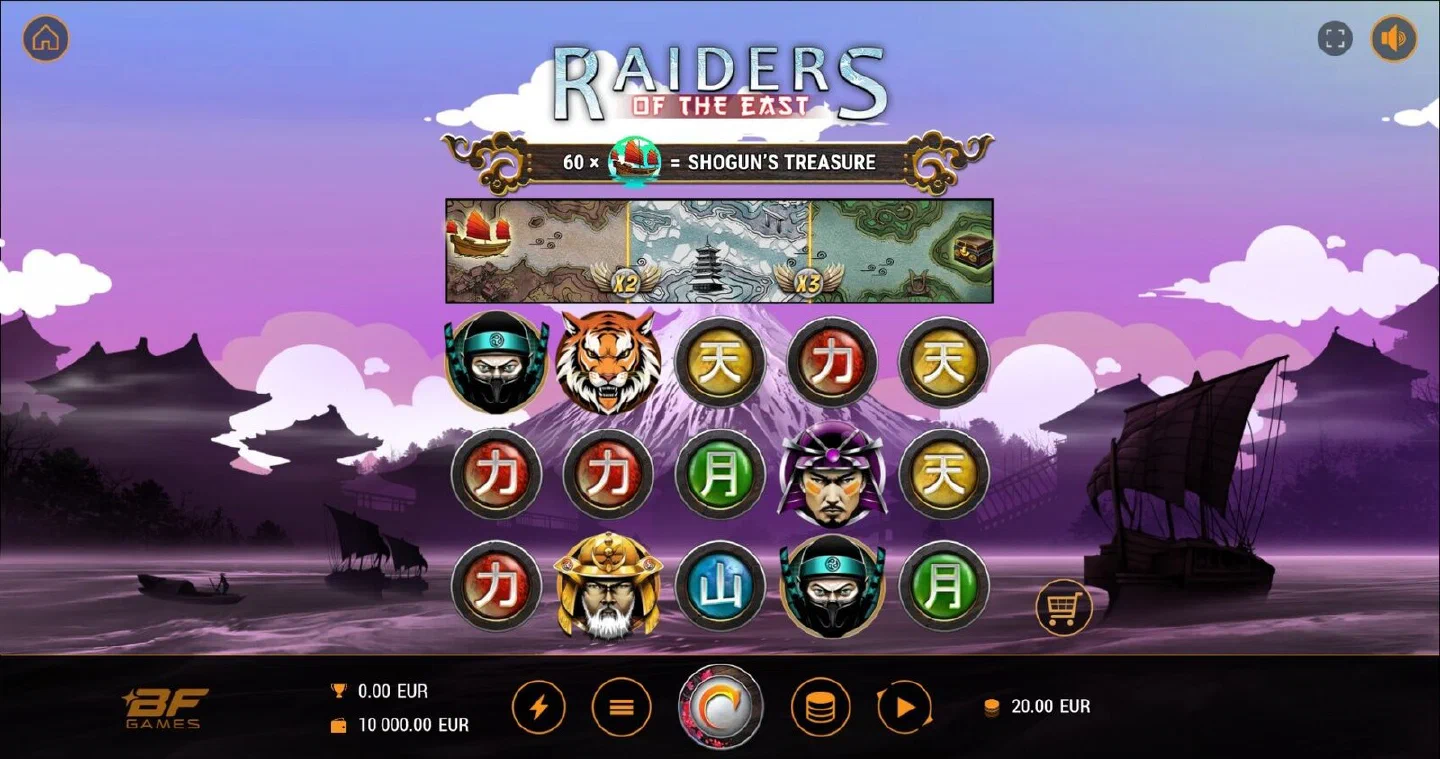
Sixty ships is a goal with three marked stages rather than a single lucky screen, which is what makes it worth planning a session around.
- The first twenty pay for themselves in wild tier: the base game starts paying multiplied instead of flat.
- The next twenty raise it again, and on a three-Shogun way at a 0.10 bet that is 0.20 turning into 0.60 for exactly the same three symbols.
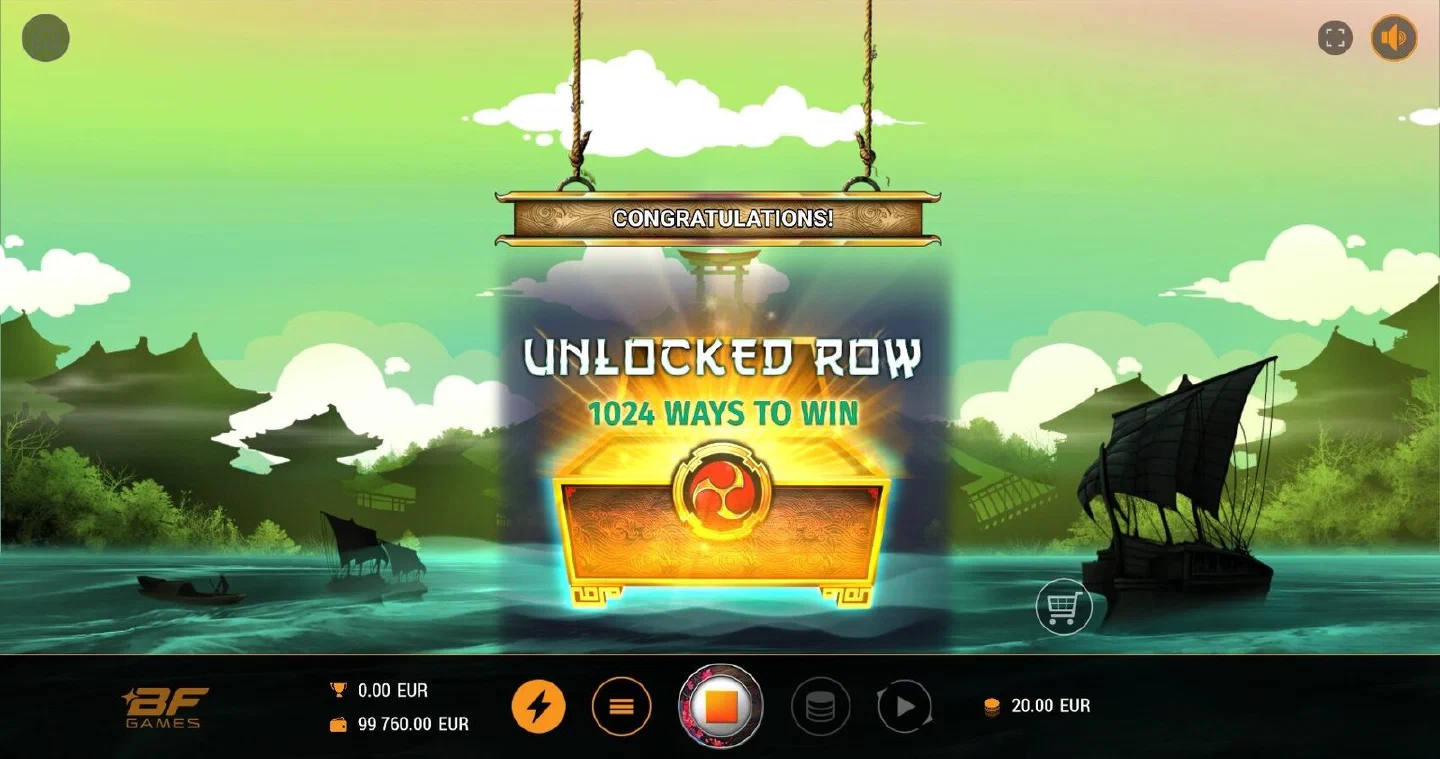
- The last twenty open Shogun’s Treasure: a fourth row, a 5x4 board with 1024 ways, Reel Wild on reels 2, 3 and 4, and a Bonus Respin to mark the moment.
The crucial property is that Shogun’s Treasure stays active until the session expires. It is not a timed bonus. So the arithmetic of a session is simple: the earlier in your budget you reach sixty ships, the more of your evening is spent on the better board.
That leads to one clean piece of pacing advice. If your budget allows either a long run at a small stake or a short run at a large one, the long run suits this game better, because every ship lands in the base game and the base game is what a longer run buys you more of. A high-stakes sprint that stops at forty ships has bought the setup and skipped the payoff. The features page explains exactly what the payoff consists of.
Buying the Free Games: when it makes sense#
The purchase is a choice with a published price and a published return, not a technique. 45x the base bet while the fourth row is locked, 55x once it is open. The rounds read 96.06% and 95.93% against 96.3% in the base game, so you are giving up a fraction of a percentage point for immediacy.
It helps to look at that price from three angles before you sit down.
As spins. A 45x purchase costs what forty-five base spins cost at the same stake, and a 55x purchase what fifty-five cost. If you would happily sit through that many base spins, the purchase is a swap rather than an extravagance. What it does not do is shorten the road to the fourth row: ships fall in the base game, so a bought round leaves the counter exactly where it was.
As a share of budget. Set the rule before you sit down. One workable approach is to treat purchases as a fixed slice of the session budget, say one buy for every defined block of base play, and then stop deciding. At a 0.10 stake that slice is 4.50 a time; at 1.00 it is 45.00, and the rule matters more with every step up.
As a state of the game. Buying at 45x puts 10 Free Games onto a 5x3 board. Buying at 55x puts the same round onto a 5x4 board with 1024 ways and Reel Wild live during the spins. The second is the configuration the 3168x ceiling is designed around, and it is the stronger case even though it costs more.
Whichever path you take, the key ladder is identical: 3, 6, 9 and 12 collected KEYs each add 2 spins and lift the round multiplier to x2, x3, x4 and x5, from the same 3 SCATTERs on reels 1, 3 and 5 that trigger the round naturally.
Two session shapes that both work#
Two session shapes fit this game, and the difference between them is decided before the first spin rather than during it.
The collector. One stake, held from the first spin, turbo on, autoplay running through the base game. The goal is sixty ships, and the budget is sized so that the run is affordable with room left over to play on the open board afterwards. This shape suits smaller stakes and longer evenings: at 0.10 a spin, 200 base spins cost 20.00, and every one of them counts toward the same 20, 40 and 60.
The buyer. A stake chosen so that 45x is a comfortable unit, with purchases made on a rule rather than a whim. The collection still happens in the background between buys, and once the fourth row opens the purchases become 55x onto a much better board. This shape suits shorter sessions and players who would rather see free-games rounds than base spins.
What fails is the hybrid: base spinning at one stake, an impulse buy at another, a step up after a quiet stretch, a step down after a loss. Every one of those moves scatters ship progress across counters and none of them affects the 96.3% return. Pick a shape at the start, and the rest of the session mostly plays itself.
Where the ceiling actually sits#
The top prize here is 3168x your own bet inside one round, not a share of a pot fed by every other player in the lobby. That matters for planning, because it means the maximum is reachable from any step in the range and never asks for a separate qualifying stake.
At 0.10 the ceiling is 316.80. At 1.00 it is 3168.00. At the 100 top step the provider publishes, it is 316800.00. Whatever you choose, the path is the same: a multiplied wild, an open fourth row and a key ladder running toward x5. None of those needs a larger bet to appear.
So the honest framing of stake size is about session length rather than about access. A bigger bet buys a bigger number if the round lands; it does not buy a better chance of the round landing. Pick the stake that keeps you playing long enough to assemble the machinery, and read the full review for how that plays out over an evening.
Stopping rules that actually work#
A limit chosen before the first spin is the only kind that survives contact with a good round. Four that hold up well in a high-volatility game:
- A session budget in money. Decide the figure, and treat reaching it as the end of the session rather than as a reason to raise the stake.
- A time limit. Turbo and autoplay make the spins fly past, so the clock is often the more honest limit of the two.
- A rule for winnings. Decide in advance what happens when a large round lands, whether that is banking a share or stopping outright, so the decision is made when you are calm.
- A rule for the stake. One step, held. Chasing a quiet stretch by doubling the bet resets your ship progress and shortens the session at the same time.
None of this changes the odds of a spin. The random number generator decides each round and the result cannot be predicted or influenced. What these rules do is keep the game inside the space where it is entertainment, which is the only place it is worth playing.
If you want to rehearse the pacing without money involved, the free demo runs the same build, and the slot hub collects every page in this set. The responsible gambling page covers deposit limits, reality checks and time-outs in detail.
18+. Nothing on this page changes the odds of a spin: the 96.3% return belongs to the game over millions of rounds. Decide your limits first, and the responsible gambling page shows how.